Sunday, October 26, 2014

October Garden Report


Maintenance has gotten easier. I haven't needed to water much this month at all. The garden isn't exactly still going strong, but it is still going.

I recently picked squash and zucchini, and made bread with them. I picked some peas and beans too.

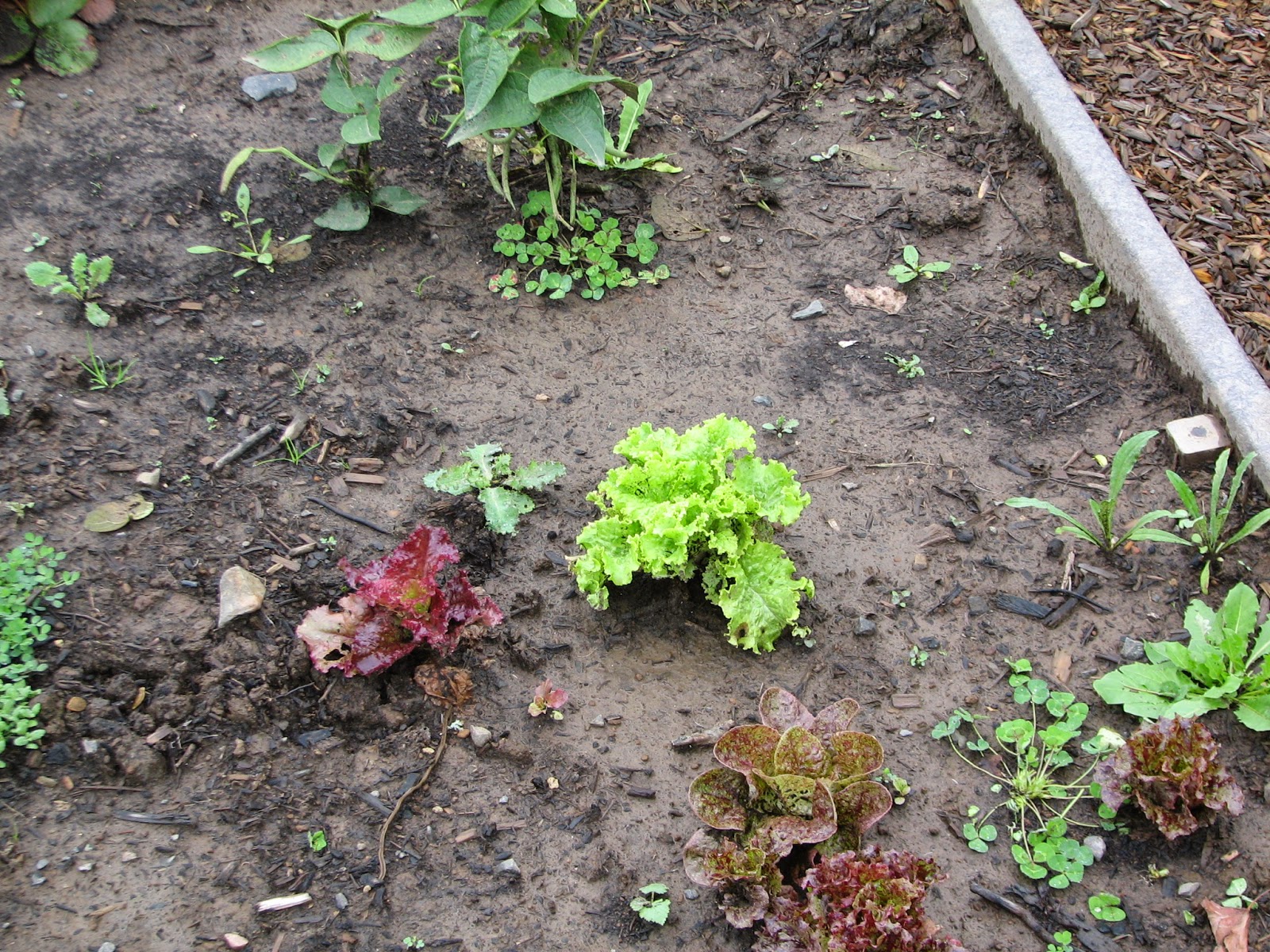
I am having a hard time deciding if I should pick the lettuce. It's not very big, but it's been holding at this size for a few days now. It may not get any bigger.

The tomatoes will ripen. I was guiding the branches on one of the plants, and one hard green tomato fell off. I thought it was too green for putting it on the counter to work, but it did. If that one can ripen, all of these can. I still have it in mind that it is superior for them to ripen on the vine, but every day that I leave them out there is one more day that they can fall and be eaten by slugs. I thought I would gather everything at the first sign of frost, but I think it will happen before that.

The last few zucchini may not ripen, and that's okay. If they do I will use them, and if they don't, it's still part of this thing that inspires me, in that the plants will keep going for as long as they can.

With the tomatoes, everyone has a lot of tomatoes still green or ripening, but the strawberries are still putting out new fruits. I thought they were done, but I picked two strawberries two days ago that were ripe! In October! It's not like you can make jam from it, but it's still kind of cool, this drive to produce and to choose life.

Also, I had no idea how long-lasting marigolds were.

So that's where I'm at now. I am deciding when to pick what is left, based on the progress that I'm observing.

I also need to make decisions about next year. Do I want to keep the plot? If I do, do I want to grow the same things?

That sounds like I don't need to decide right away, but there are winterizing things I can do, and if I am going to do them, we are getting into the right time.

Therefore, there will be a November garden report. It will be partially a post mortem, but it will still have an eye to the future.

Sunday, October 19, 2014

Okay, now you're just looking for a reason to be offended

I just have one more post based on thoughts from conference for now.

I have mentioned before that I am in this online group for left-leaning members, and that I kind of hate it, so I don't look at it much. If anything interesting comes up, my sister will usually ask me if I have seen it, and that is why I stay in.

The first thing she mentioned for conference was how upset people were by Elder Christofferson's talk about takers and the 47%.

I didn't remember the talk being about that. For one thing, I am really sensitive to the 47% thing (see http://sporkful.blogspot.com/2012/10/100-wrong-about-47.html for more on that), so I think it would have stood out if he had said that. I remembered the focus as being on how you need to repent to take advantage of the Atonement, and that keeps agency as a part of the process of forgiveness. That was what stuck out to me.

I decided the example of the really lazy man was pretty ludicrous, though, and maybe that was where they felt he was making it more about the temporal. It still seemed like an overreaction, but I had not read their actual comments. Maybe the comments had looked worse to my sister, who had not actually listened to the talk.

But I still saw the comments about Elder Scott's talk.

I feel like it would be inappropriate to copy the main person's comments here, though I have them handy, so I totally could. I am also concerned that by only summarizing the complaint, it will be open to misinterpretation, and sound worse, or maybe I have misconstrued it. So, I will probably do a kind of a mix.

First of all, the talk did admit that life can be hard. Here is one quote from Elder Scott:

"We live in trying times. I need not list all of the sources of evil in the world. It is not necessary to describe all of the possible challenges and heartaches that are a part of mortality. Each of us is intimately aware of our own struggles with temptation, pain, and sadness."

However, he does not focus so much on that but on the various tools we have to help with that. The complaint was centered on his comment on prayer. Again, from Elder Scott:

"The first tool is prayer. Choose to converse with your Father in Heaven often. Make time every day to share your thoughts and feelings with Him. Tell Him everything that concerns you. He is interested in the most important as well as the most mundane facets of your life. Share with Him your full range of feelings and experiences.

Because He respects your agency, Father in Heaven will never force you to pray to Him. But as you exercise that agency and include Him in every aspect of your daily life, your heart will begin to fill with peace, buoyant peace. That peace will focus an eternal light on your struggles. It will help you to manage those challenges from an eternal perspective.

Parents, help safeguard your children by arming them morning and night with the power of family prayer. Children are bombarded every day with the evils of lust, greed, pride, and a host of other sinful behaviors. Protect your children from daily worldly influences by fortifying them with the powerful blessings that result from family prayer. Family prayer should be a nonnegotiable priority in your daily life."

The negative comment that started a long discussion, and to be fair it was not all agreement, took this as looking at the world as full of evil people, plus Satan and his minions, ready to pounce on you, and she was bothered by that because she likes to think of the world as beautiful. If we are going to love our neighbors, isn't it counterproductive to view them as evil? Why is he being a fear-monger?

And I know there is a whole talk that was given, and I have only referenced three paragraphs, but seriously, he never said to fear non-members. The church has some anti-bullying information out there, because LDS kids bully too. Maybe you are praying for protection from the people at church, or from depression, or for help in dealing with all of the personal things that make life difficult that everyone has. It's not saying that life isn't beautiful because it's hard; a lot of the beauty comes through the hard parts!

I think at this point, she was projecting. Now, I absolutely know it is possible, especially living in Utah or Idaho, that there might be a lot of people talking about the wickedness of everyone outside of the church, and that would be frustrating, but don't inject things into the talks that aren't there! For one thing, if you are listening for what other people need to hear, you will not hear what you need to hear. There could have been something that would comfort you in there.

It's interesting because we have friends who have told us that 91% of conference is because of what people do in Utah, and I think we are moving away from that. Various speakers spoke in their native languages, and that was exciting. We are a worldwide church, and the Gospel has value for every citizen of the globe.

This is something else that has become clear to me though. The conservatism that is associated with the Church in the States is not worldwide. I suspect part of the reason for those who feel that Republican is the only way to be is because of the political climate that the GOP has been working very hard to build, which associates their cause with righteousness and which is based on lots of lies. So, that's something worth thinking about.

And for someone who is very satisfied with both their political and religious affiliation, a message that repentance is necessary, when they have not thought of themselves as needing to repent, can be very valuable, if they will hear it. A reminder for daily prayer, which can, if the prayer is sincere, soften the heart, and become a conduit for personal revelation, can be very useful.

The question really becomes what are you looking for? Because you will find it.

http://preparedspork.blogspot.com/2009/05/may-2009-on-not-being-offended.html
Sunday, October 12, 2014

Faithening Strength

I wrote last week's post with one session of conference remaining, and there was something coming that would touch me deeply.

Elder David F. Evans gave the invocation, and expressed gratitude for the opportunity to have our strength faithened. He quickly realized what he said and corrected it, but I was amazed by how natural the first way sounded, and believed that there was something profound there.

My first thought was of Matthew 13:33:

"The kingdom of heaven is like unto leaven, which a woman took, and hid in three measures of meal, till the whole was leavened."

Perhaps faith was something that could start in a small part of your strength and grow until it it was a very faithful strength. That sounds powerful, and we use analogies of seeds and plants growing for faith all of the time.

We have a general feeling that our faith should be strong, and an idea of how to go about making that happen. It is less common to think about how our strength should be full of faith, and how to make that happen.

I believe that a lot of time could be spent on this simple phrase, and there would be insights and inspiration. These words are in no way definitive, but here are some thoughts that I had on faithening our strength.

1. We can increase our appreciation and gratitude for our physical strength and abilities.

There is so much that is amazing about the human body, with the interactions of nerves and muscles and brain function that goes into even the simplest things like walking, grasping, or lifting. Even with your body set up to work correctly it needs nourishment, which means sunlight and chlorophyll and photosynthesis and digestion. Along with these basic functions come pleasures like taste and hearing the sound of crunching.

There is so much to appreciate, as individual components and as parts of systems, but they can easily be taken for granted. Devoting some time to noticing how all has been provided could indeed make your strength more faithful.

2. We can increase our appreciation and gratitude for the steps that led to our current level of spiritual strength.

In many ways, my family's spiritual history begins with a broken projector. The elders needed it repaired, and came to my grandfather's electronics shop where an uncle invited them back. My parents did listen, and did get baptized. Because of that I was born in the church.

Going forward there was that time a speaker said you should read the scriptures daily, and it resonated with me and I started, and the things I learned there. There have been the times when things were whispered to me, and felt, and ways in which others served me and I served them. There was the time when the Spirit practically shouted at me to serve a mission, and I listened, and what happened right after that and for the next few years after that. There is a process, full of many building blocks, that led to my present state of activity, and there were many beings who helped. That is worth remembering, because there was faith that led to that strength.

3. We can apply faith to our strengths and talents.

What have we accomplished already in the service of God? What things might we be intended to accomplish?

One thing that disturbs me a lot is that fear of pride has caused many people to discount their own abilities. That leads to unhappiness as we feel inadequate, and less, but we can nonetheless all do many things and it does not benefit the world to hold back because we think we can't be enough.

As we examine the past, for times we have helped others, even if it was simply by listening them, then we can build on that and move forward and do more.

This is only an ego problem if you use this as evidence of your own superiority. If instead you acknowledge the large debt you have to God for your abilities, and acknowledge that all others have their own gifts, and that we need the gifts of all to achieve the most good, then you will not be proud, you will be humble. Your strength will be faithful.

In my life right now I am trying to pursue dreams that I have wanted for a long time. It is very easy to doubt. It is very hard to believe that what I want is possible or deserved.

But I have a patriarchal blessing, with promises in it. That includes references to the talents that I am trying to build on now. I have faith that my Heavenly Father loves me and wants me to be happy, and knows what will make me happy. So if I feel pulled down one path, and there is confirmation, even without fully knowing where the path will lead I can feel confident setting out on it, that my strength will be enough, or that I will be shored up when my strength lacks.

I can have faithened strength.

Sunday, October 5, 2014

Taking the sacrament

It is General Conference weekend. Twice a year in my church we have two days of talks from our leaders, and they will later be printed in a magazine, but also available on line.

https://www.lds.org/general-conference/sessions/?cid=HP14GC&lang=eng

Since there is already so much to listen to and think about out there, I don't want to add very much.

I usually get more out of reading than listening, and as I write this there is still one session left, so my impressions could change. Knowing that, I say that the dominant theme of this conference has been the emphasis on taking the sacrament.

At first I was surprised, but it is striking me as more and more perfect.

One thought I had with the last conference is that no matter how much you might want some things said, so that some people will hear them, that doesn't work. If the person is not ready to hear it, they won't. If you are ready to hear something, and you are listening, you will  hear it, even if it is not said.

I think about that because the thing that worries me most about church members is the growing hard-heartedness. Yes, it is more to the point to worry about myself, but I do see things that worry me in other people, and that is one.

"And because iniquity shall abound the love of many shall wax cold." Matthew 24:12

It's easy to read descriptions of the Last Days and think that they apply to people outside of the church, but that would be pretty short-sighted.

So I think about that, and about people who know the truth, but they get so busy judging the lives of others that they forget to love them, and foolish virgins and sheep and goats, and I worry, but the sacrament is the best remedy for that.

It is a time to reflect on ourselves. How am I doing? How could I be better?

It is a time to feel humility and seek forgiveness.

It is a time to listen for the messages we need to hear.

It is a time of heart softening, and we can have it every week.

Having church leaders called of God is a wonderful thing, but even if we are not acting as leaders at a given moment, we are still called. It is important to regular take time to hear Him calling.


Sunday, September 28, 2014

September Garden Report


Autumn has fallen upon us and the garden is starting to wind down.

The strawberries are alive, but not really producing. The green beans may still produce some, but I am not counting on it.

One of the tomato plants is done, but two others continue to bear fruit. However, ripening happens slowly, and the first frost that we get will kill them all, so I now need to keep an eye on the weather forecasts. The first time it looks like we will dip below freezing, I will pick everything left and see what sitting on the counter can do for them.

However, the second planting of peas and the lettuce seeds are growing. That frost could still ruin everything, but I continue to hope.

I am still getting some new zucchini and crookneck squash, but they are not getting as big. I am not sure how much longer they will last. The pumpkins would have actually thrived under cooler conditions if they had grown, but that leads me to one of the big questions of this whole gardening experiment - why didn't they grow? I am starting to think that they simply mutated.

I guess the idea was planted when talking with one friend about gardening, and worrying about nutrient sharing and competition, and she mentioned in passing that the only risk was squash cross-breeding.

At the time it didn't seem important, but yes, there are many different kinds of squash, some of which are quite similar to each other. I would not automatically be suspicious that the crooknecks are thriving and that I never got a single pumpkin fruit, but there are a few things that make me wonder...

1. One of the crookneck vines is extending from the area where I planted the pumpkin seeds. Things can get mixed up a little, but it is pretty far away from where I put the crookneck seeds.

2. Some of the crooknecks are suspiciously orange, instead of the regular pale yellow. Are they really mutated crumpkins?

3. One of the other garden patches has some squash that are dark green and elongated at one end, but yellow and narrow at the other. Crookini?

My zucchini have remained intact, but they started as plants, and had time to get established while the crookneck and pumpkin seeds were just sprouting.

Really, the most suspicious thing is that yet another garden patch has some thriving crooknecks in the space that they planted watermelons. Are crooknecks like the Borg? You have been squashimilated?

Fortunately, they are pretty flexible for cooking. We have sauteed them with onions, cooked them au gratin with zucchini, and baked them with sausage. I think I will be trying squash breads and cookies soon.

Sunday, September 21, 2014

Preparing to have a mission

I know, in the church that means something else. However, we also have our own definition of calling, where most of the world uses it more in the way Newport does, as something you feel drawn to as a life purpose, and a sense of mission goes along with that.

The final section of So Good They Can't Ignore You is Rule #4 Think Small, Act Big (Or, the Importance of Mission). It starts with a chapter called "The Meaningful Life of Pardis Sabeti".

http://en.wikipedia.org/wiki/Pardis_Sabeti

I still recommend reading the book, but if not, Sabeti's Wikipedia entry is still pretty impressive. What she does with her work is impressive, but there is also impressive field and charity work, and she plays in a band and in a volleyball league. It is a good life, and she does a lot of good in the world.

It is also a life that demonstrates the previous rules coming together. She did not automatically know what field she would work in, but worked at it, developing her skills and becoming very good at what she could do. She has skills that people are willing to pay for, and it gives her some control, both for the projects she sets up and for giving her the time for a personal life. As she goes down that path, she finds more things she can do.

For me the most intriguing part of this sentence was a reference to "the adjacent possible". The idea is that at the edges of what we know, there are new discoveries for which the base is already in place. Once those discoveries happen, they become the base for more knowledge and innovation, but at any given moment there are some things that are available.

The description made me want to know more, which is why I am now reading Where Good Ideas Come From by Steven Johnson. (For what it's worth, I also recently finished Talent is Overrated by Geoff Colvin because I wanted to know more about deliberate practice.)

I believe Newport mentioned Crick and Watson's discovery of the double helix formation as an example of a breakthrough that other people were working on simultaneously, and Johnson covers many more such examples, but there were two things that I got from Johnson's book that relate to Sabeti.

One of the common characteristics of people who make large discoveries or innovations is that they have hobbies, or they have studied other things. Working out the double helix required tools from biochemistry, mathematics, genetics, information theory, and a sculpture metaphor. And, perhaps because it is so impossible for one person to know everything, it is important to have contact with different sorts of people in different fields.

From that way of thinking, it is not just that part of a good career is that it gives you a chance to play volleyball against the other departments, or play in a band and spend time with musicians and music fans, but that it makes you better able to do well in your job.

I know many members whose jobs have been influenced in some ways by their time spent in the mission field, if for no other reason than that they have picked up a new language. I have also heard stories of older couples going on service missions where they use knowledge acquired in their career to serve others.

Even without a formal mission in the mix, life can be like this. We learn, we connect to people, we learn more, and there is a circle where knowledge leads to knowledge, connection leads to connection, and we not only make our own lives better but the lives of other people. That is something worth working for.

Sunday, September 14, 2014

Preparing to exert career control

We are now at Rule 3: Turn down a promotion (the importance of control)

Newport used to opposite examples to demonstrate this principle. One example had written up a list in her early 20's of things she wanted to do. They included making her way across each continent without normal power, like maybe unicycle for one, and dog team for Antarctica, learning to eat fire, and surviving in the wilderness for a month without supplies. She dropped out of school to do this, but then found her job prospects did not really support her goals.

The other started out with a very basic entry level code testing job, but she became very good at it, learning ways to debug and automate and consistently rising in terms of her level of ability and responsibility. She then was able to request various things that they would not normally give, like Fridays off, or a three-month leave. If the first person had followed that kind of a path, she would have been more likely to be able to follow her interests.

One point of this is that you have to be able to offer something that people will pay for. Someone who has traveled the world by unconventional means may be interesting to talk to, but it doesn't automatically make them a good employee. Even if you look for ways to monetize it, by writing a book or creating a reality show, there are no guaranteed sales.

The most detailed example was about Red Fire Farm: http://www.redfirefarm.com/

As a teenager Ryan tried various things for making money, including some very typical ones. One of those ended up being selling wild berries that he picked. That led to selling extra produce from his parents' garden, then taking over the garden, expanding the garden, and renting land to grow more. By the time he was ready to purchase his own land, he had acquired career capital that he could put to work. It started as a way to simply make cash, but it became a career.

One thing worth noting is that the first few rounds wouldn't have required much of a financial investment. If the berries hadn't sold, he could have moved on to something else easily. As he succeeded, there was a gradual progression to bigger things. At various points the risk would increase, but there had been a commensurate increase in knowledge and experience before each expansion. He is now doing what he wants in the way he wants, but it started small.

As the proprietor of a family business, he has control, but also has responsibility for his own financial well-being, which is going to affect decisions. When you work for an employer, you may have less risk, but also a trade off with less freedom, and that requires other decisions. That's where turning down promotions may come in.

I have a friend who works at a large chip manufacturer, and is not on the typical career path where he should be seeking higher advancement. He is looked down on for that, but he knows that the normal route will seriously compromise family time, and mental health, and evaluating what his family needs are financially and emotionally, has made his choice. That takes some strength, but it also takes clearheaded analysis.

This section of the book had many examples of people who did turn down promotions or walk away. When you are valuable to your employer, they may want to nail you down more. They will probably not want you to be gone for three months or to work four days a week. If that's what makes the situation workable for you, that may work, as long as you have something to offer them that is worth the concession.

For the woman who did take the three-month leave, part of it was that in preparation for it she trained her team to function without her. She wanted to know that they could do it, it would be a relief to her company to know that while she was valuable she was not irreplaceable, and it was probably good for the individual team members to expand their abilities.

Exerting career control is a two-part process. One is knowing what you have of value, so that you have something to offer and to barter with. In addition, you also need to know what you value, so that you can decide the worth of various options. Combining those things can help you build a desirable career.